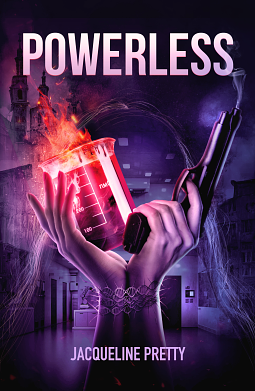
Powerless by Jacqueline Pretty is a novel that leans into the tension between vulnerability and resilience, asking what happens when ordinary people are stripped of their usual safety nets. It is both a character-driven story and a thematic exploration, placing its protagonists in circumstances where survival, identity, and moral choice come under scrutiny.
At its heart, the book is less about grand battles or spectacular powers and more about the absence of them. Pretty plays with the common assumption in speculative fiction that someone—or something—will always come to the rescue. Instead, she situates her story in a world where the expected shields are gone, leaving the characters exposed. This premise creates a compelling narrative framework: readers are drawn into situations where the usual tropes are inverted, and the focus turns to raw human ingenuity and emotional strength.
Thematically, Powerless dives into questions of autonomy, responsibility, and what it means to matter in a world where external forces often dictate fate. It poses subtle but powerful dilemmas: how do individuals act when stripped of control? What does bravery look like when there are no special abilities to lean on, no guarantees of success? In asking these questions, Pretty manages to highlight the value of seemingly ordinary decisions, reframing them as monumental acts of courage.
Pretty’s writing style is sharp yet accessible. She maintains a balance between evocative prose and page-turning momentum, making the book appealing both to casual readers and those who enjoy unpacking layered meaning. The pacing is deliberate: moments of quiet introspection are juxtaposed with bursts of tension, ensuring that the reader never becomes too comfortable. This rhythm mirrors the experience of the characters themselves, who are constantly caught between calm and crisis.
The novel’s setting, though not overloaded with description, feels tangible. Pretty gives just enough detail to situate the reader in an environment that is both familiar and slightly askew—an almost-real world where the stakes feel heightened precisely because they are not fantastical. This grounding allows the emotional arcs of the characters to resonate more deeply.
Characterization is one of the strongest aspects of Powerless. Rather than relying on archetypes, Pretty crafts individuals who feel nuanced, contradictory, and fully alive. Their flaws are just as important as their strengths, and their inner struggles often matter as much as their external conflicts. Readers may find themselves both admiring and questioning their choices, which is part of the book’s appeal: it doesn’t offer simple heroes or easy answers.
Ultimately, Powerless is a meditation on strength found in unlikely places. It underscores the idea that human value does not come from extraordinary gifts but from persistence, relationships, and the ability to make choices in the face of uncertainty. The book leaves readers reflecting not on what was missing, but on what was revealed when nothing external could be relied upon.
For anyone seeking a thought-provoking story that upends expectations while remaining deeply human, Jacqueline Pretty’s Powerless is worth the read. It is gripping, intimate, and above all, a reminder that even in the absence of power, there is agency—and in agency, a different kind of strength.








 Amazon
 Apple Books
 Bookshop.co.uk